The Ultimate Guide to Ecommerce Survey Questions
In today's competitive ecommerce landscape, understanding your customers' needs, preferences, and experiences is crucial for success. Customer feedback not only helps identify areas for improvement but also highlights your strengths. This valuable information can guide your decision-making process, resulting in better user experiences, increased customer satisfaction, and ultimately, higher conversion rates and revenue.
With the vast array of digital tools available, there are many ways to gather customer feedback. One of the most effective methods is conducting surveys. Surveys allow you to gather insights directly from your customers, providing you with actionable data to make informed decisions and continuously improve your ecommerce business.
In this guide, we're going to take a look at the best questions to ask, and when to ask them. Implementing simple customer surveys at the right points in your purchasing journey can help you learn more than you ever thought possible - just by asking your customers questions!
The role of surveys in understanding customer preferences and improving overall experience
Ecommerce surveys play a vital role in understanding customer preferences and improving their overall experience. By asking the right questions, you can gain insights into various aspects of your online store, such as website usability, product offerings, pricing, shipping, and customer support.
Surveys can be conducted at different stages of the customer journey, from pre-purchase to post-purchase. Pre-purchase surveys help you understand why visitors browse your store without making a purchase, while post-purchase surveys provide insights into the shopping experience of customers who have completed a transaction. Combined, these insights can help you make strategic improvements to enhance the overall customer experience, leading to increased customer loyalty and repeat business.
In this ultimate guide, we will walk you through the process of creating effective ecommerce survey questions to gather meaningful feedback, understand customer preferences, and improve the overall shopping experience on your website. We will also cover best practices for survey design, analysis, and follow-up actions.
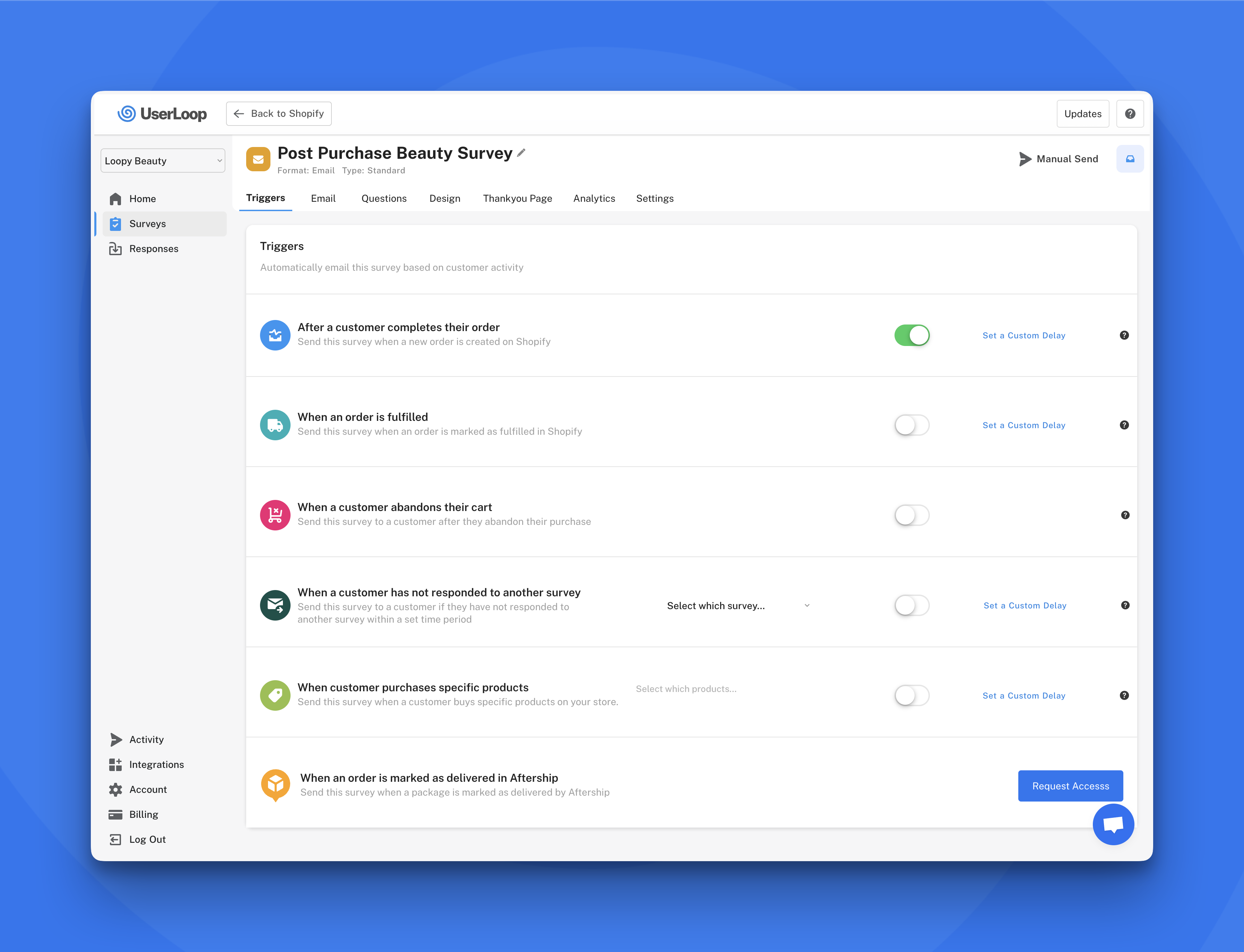
**It's important to pick a survey tool which allows you to trigger a survey based on a wide range of customer actions, such as when their order is delivered or they abandon their cart.
Types of Ecommerce Survey Questions and Examples
A. Pre-Purchase Survey Questions**
Pre-purchase surveys help you understand the needs and expectations of visitors who browse your store without making a purchase. This information can be used to improve their experience and increase the likelihood of converting them into customers. Here are some examples of pre-purchase survey questions, grouped by category:
1. General
How likely are you to recommend our website to a friend or colleague? (Net Promoter Score question)
How satisfied were you with your overall experience on our website?
What improvements can we make to enhance your experience? (open-ended question)
2. Website
How did you learn about our website? (options: TV, Newspaper, Social Media, Search Engine, Recommendation from a friend, Other)
Who were you shopping for? (options: Friend, Parent, Boss, Colleague, Other)
Did you find what you were looking for on our website?
Are you planning to return later to complete a purchase?
3. Product Reviews and Ratings
How much do you trust the product reviews on our website? (scale of 0-10)
How helpful do you find ratings while making a purchase decision?
4. Product Catalog and Quality
Did you find a sufficient range of products on our website?
Were there enough product details available for your decision-making process
**Using an AI powered survey tool like UserLoop can help you write questions tailored to your brand and category using AI.
B. Post-Purchase Survey Questions**
Post-purchase surveys provide valuable insights into the shopping experience of customers who have completed a transaction on your website. This information can be used to improve various aspects of your online store and enhance customer satisfaction. Here are some examples of post-purchase survey questions:
1. Online Shopping Experience
How satisfied were you with the quality of our products?
How was the checkout experience overall?
How likely are you to buy from us again? (scale of 0-10)
2. Shipping
Did you receive your product within the expected timeline?
How satisfied were you with the delivery process and personnel?
3. Customer Support
How would you rate your experience with our customer support team? (scale of 1-10)
Did our customer support team resolve your issue or answer your question?
C. Incentivizing Survey Participation
We're one of the leading survey platforms and have access to a huge amount of data on what works and doesn't work when surveying your customers. One of the most important things we've observed is that offering your customers an incentive to complete your survey can make a massive difference in your response rate. And can actually be a great way to drive sales
Gift Cards and Store Credits
Gift cards and store credits are another attractive incentive for survey participants. By providing a store credit or gift card, you allow customers to choose what they would like to purchase.
This flexibility often results in higher satisfaction and a stronger sense of loyalty. You can offer these incentives in various amounts, depending on the length and complexity of your survey. For a seamless experience, integrate the gift card or store credit system into your ecommerce platform to ensure easy redemption.
Exclusive Access or Free Samples
Offering exclusive access to new products or providing free samples can create a sense of exclusivity and excitement among survey respondents. By giving customers a sneak peek at upcoming releases or the chance to try out new products, you not only encourage survey completion but also create buzz around your brand.
This incentive works particularly well for companies that regularly release new products or have a dedicated following of loyal customers eager for the latest offerings.
Contest Entries and Giveaways
Contest entries and giveaways can serve as powerful incentives for customers to complete surveys. By entering respondents into a contest or giveaway, you create an element of excitement and fun.
Customers will be more likely to participate in the survey if they feel they have a chance to win a valuable prize, such as a high-end product, a large gift card, or a unique experience. Be sure to clearly communicate the contest rules, the prize, and how the winner will be selected to ensure transparency and encourage participation.
Types of Ecommerce Survey Questions
In order to gather valuable customer insights and improve your ecommerce store's overall experience, it's essential to ask the right survey questions. These questions can be grouped into three main categories: pre-purchase, post-purchase, and general survey questions.
A. Pre-Purchase Survey Questions
Pre-purchase survey questions aim to understand the expectations and preferences of potential customers who visit your online store but have not yet made a purchase. These questions can provide valuable information about your visitors' browsing experience and help identify areas for improvement. Some examples of pre-purchase survey questions include:
What led you to visit our website today?
How easy was it to navigate through our site?
Did you find the product information helpful?
How would you rate our website's performance compared to our competitors?
B. Post-Purchase Survey Questions
Post-purchase survey questions are designed to gather feedback from customers who have made a purchase on your ecommerce store. These questions help you understand the quality of the customer experience, from product selection to checkout and shipping. Some examples of post-purchase survey questions include:
How satisfied are you with the quality of our products?
How was your overall checkout experience?
Did you receive your product within the expected timeline?
How would you rate your experience with our customer support?
C. General Survey Questions
General survey questions can be used at any stage of the customer journey to gauge overall satisfaction and gather feedback on various aspects of your ecommerce store. These questions are useful for getting a broad understanding of your customers' experiences and preferences. Some examples of general survey questions include:
On a scale of 1-10, how likely are you to recommend our store to a friend or colleague?
What aspects of our store do you like the most?
What can we do to improve your experience with our store?
Are there any products or features you would like to see in our store?
Picking the Best Ecommerce Survey App
Choosing the right ecommerce survey app is crucial for collecting valuable customer feedback efficiently. There are numerous survey tools available, each with its own features and capabilities. Here are some factors to consider when selecting a survey app for your ecommerce business:
It can be hard to know which app to go with when deciding how to survey your customers. Thankfully, we've written a post covering the best Shopify survey apps.
1. Ease of Use
Opt for a survey app that is user-friendly and easy to navigate, both for you and your respondents. An intuitive interface can streamline the process of designing, deploying, and analyzing surveys.
2. Customization
Choose a survey app that offers a high degree of customization, allowing you to tailor the design and appearance of your surveys to match your brand identity. This can help improve response rates and maintain a consistent brand image.
3. Integration
Select a survey app that can seamlessly integrate with your ecommerce platform, CRM, and marketing stack. This will allow you to easily sync data and automate processes, ultimately saving time and improving efficiency.
4. Reporting and Analytics
Look for a survey app that provides robust reporting and analytics features, enabling you to track response rates, analyze trends, and gain actionable insights from your survey data.
Writing Questions Targeted to Your Category (Fashion, Cosmetics, Food, etc.)
When designing an ecommerce survey, it's important to tailor your questions to your specific industry and product category. This will help you gain more relevant and actionable insights. Here are some examples of targeted survey questions for different industries:
Apparel and Fashion
What is favorite clothing trend right now?
What occasions do you typically purchase new clothes for?
How often do you purchase clothes online?
What is your preferred price range for clothes?
Which brands do you typically buy clothes from?
Home and Garden
How often do you purchase home and garden products?
What is your preferred decorating style?
Which rooms in your home do you spend the most time in?
What is your preferred price range for home and garden products?
Which brands do you typically buy home and garden products from?
Health and Beauty
How often do you purchase health and beauty products?
Which health and beauty products do you use the most?
What is your preferred price range for health and beauty products?
What is your preferred brand for health and beauty products?
How do you typically learn about new health and beauty products?
Food and Beverage
How often do you purchase food and beverage products online?
What types of food and beverage products do you typically purchase online?
Which brands do you typically buy food and beverage products from?
How important is the ingredient quality when purchasing food and beverage products?
What is your preferred price range for food and beverage products?
Sports and Recreation
What is your favorite sport?
Which sports do you follow regularly?
What is your preferred way to engage with sports content?
How often do you purchase sports equipment?
Which brands do you typically buy sports equipment from?
For more ecommerce survey question examples tailored to your industry, check out our free library of best practice ecommerce survey questions.
Analyzing and Implementing Survey Results
Once you've gathered responses to your ecommerce survey, it's essential to analyze the data and use it to improve your online store. Here's a step-by-step guide on how to make the most of your survey results:
1. Review and Clean Data
Before diving into the analysis, ensure that your survey data is clean and accurate. Remove any incomplete or irrelevant responses to maintain the integrity of your results.
2. Identify Trends and Patterns
Analyze your survey data to uncover trends and patterns that can inform your business decisions. Look for areas where customers are consistently satisfied or dissatisfied. Use these insights to pinpoint areas for improvement and capitalize on your strengths. For tips on dealing with negative customer feedback, refer to this blog post.
3. Benchmark Against Industry Standards
Compare your survey results with industry standards, such as Net Promoter Score (NPS), to gauge your performance relative to competitors. This blog post can help you compare your NPS score with top eCommerce brands like Amazon and Shopify.
4. Develop an Action Plan
Based on your analysis, develop a concrete action plan to address areas of concern and enhance your ecommerce store. This may include improving product offerings, optimizing website navigation, or enhancing customer support. For example, if you find that customers are abandoning carts, consider implementing conversion-boosting surveys to transform abandoned carts into sales.
5. Share Results and Insights with Your Team
Communicate your survey findings and action plan with your team to ensure everyone is on the same page. This will help drive a cohesive, data-driven approach to improving your ecommerce store.
6. Monitor Progress and Iterate
Continuously track your progress and measure the impact of your improvements. Use follow-up surveys to gauge customer satisfaction and gather additional feedback. Be prepared to iterate and refine your strategies based on the data you collect.
Remember, customer feedback is invaluable for optimizing your ecommerce store and enhancing the overall customer experience. By conducting regular surveys, analyzing the data, and implementing improvements, you can foster long-term customer loyalty and drive business growth.
Using Survey Data to Fine-Tune Marketing Campaigns
In addition to improving the overall customer experience, survey data can also be used to fine-tune your marketing campaigns. Here are some tips on how to use your survey data to optimize your marketing efforts:
Identify Your Target Audience
Analyze your survey data to identify the characteristics of your target audience, such as age, gender, location, and interests. Use this information to create targeted marketing campaigns that speak directly to your customers' needs and preferences.
Refine Your Messaging
Analyze customer feedback to identify the language, tone, and messaging that resonates most with your audience. Use this information to refine your marketing messaging and create campaigns that are more likely to convert.
Test Different Offers and Incentives
Use survey data to test different offers and incentives to see which ones resonate most with your customers. This can include discounts, free gifts, and exclusive access to new products. By testing different incentives, you can identify the ones that are most effective at driving sales and customer loyalty.
Optimize Your Channels
Analyze survey data to identify the channels that are most effective at reaching your target audience. This can include social media, email, and paid advertising. Use this information to optimize your marketing channels and maximize your ROI.
Conclusion
In this ultimate guide to ecommerce survey questions, we've covered the importance of customer feedback, various types of survey questions, and tips for creating effective surveys. Now that you're equipped with the knowledge and tools necessary to create meaningful surveys, it's time to implement them in your ecommerce business and start reaping the benefits.
The ongoing process of improvement through surveys
Remember that gathering customer feedback is an ongoing process. Regularly reviewing and updating your survey questions will ensure you continue to collect valuable insights that can help drive improvements to your ecommerce store. As your business evolves, so too should your approach to customer feedback. Keep an open dialogue with your customers and use their input to make informed decisions for your business.
Building customer loyalty and trust through feedback-driven enhancements
By proactively addressing customer concerns and making improvements based on their feedback, you'll demonstrate to your customers that you value their opinions and are committed to delivering a superior shopping experience. This, in turn, will help you build customer loyalty, trust, and a strong reputation as an ecommerce brand that puts its customers first.
Keep refining your survey strategies, stay attuned to your customers' needs, and use the insights you gather to create an ecommerce experience that exceeds expectations. In doing so, you'll establish a solid foundation for long-term success in the competitive world of online retail.
Don't forget, you can sign up to UserLoop and start surveying your customers for free. It takes care of everything from making sure your survey is sent at the right moment to helping you write questions with AI powered recommendations.


The agentic growth toolkit for Shopify
Ask your customers anything
UserLoop talks to your customers at scale with surveys and contests that feed one AI-queryable dataset. AI does the setup and the analysis.
- SurveysFind out why customers buy: checkout, email, link & QR.
- ContestsGiveaways that grow your list and social following.
Free plans on both apps · live in minutes