Voice of Customer Template
Every customer has a distinct voice, but hearing and analysing each individual voice at scale can be challenging. Fortunately, the rewards are obvious, as 84% of organizations working to improve customer experience through VoC report an increase in revenue.
Luckily, there are now tools to streamline each step of a VoC initiative - from questionnaire design to AI analysis of qualitative feedback, help is at hand.
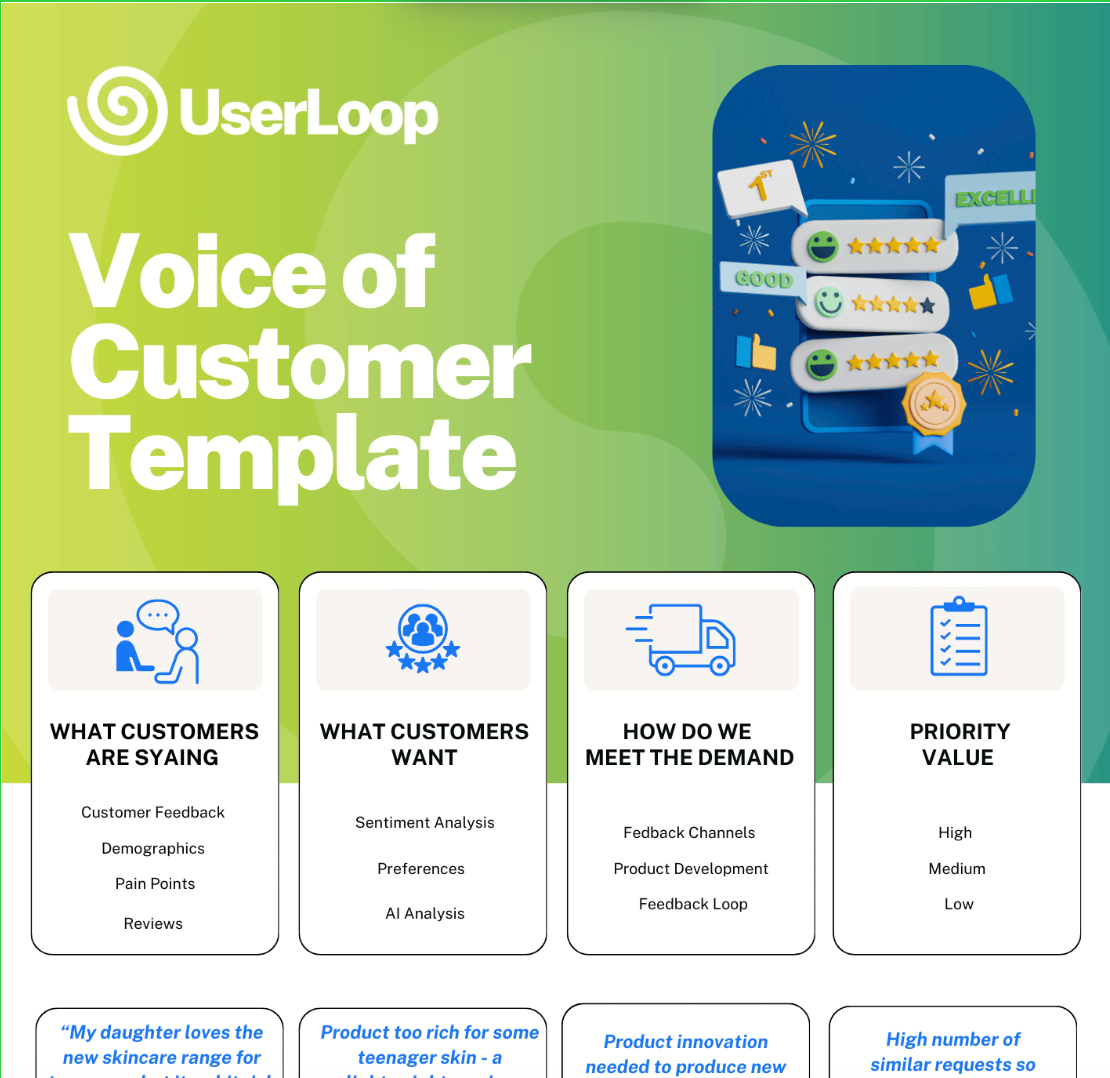
Enter our voice of customer template - your secret weapon for unlocking valuable insights into your customers' needs, preferences, and pain points.
Click Image to Download
By tapping into the power of customer feedback, you'll be equipped to make data-driven decisions that can revolutionize your product development, boost customer satisfaction, and skyrocket your retention rates.
In this guide, we'll walk you through everything you need to know about voice of customer templates. You'll discover the different types of VoC tools available, learn how to create your own custom template, and get the lowdown on analyzing and acting on the goldmine of data you'll collect. We'll also dive into popular tools like Net Promoter Score (NPS) and Customer Satisfaction Score (CSAT), showing you how they fit into the bigger picture of understanding your customers' journey and expectations. Get ready to transform your customer experience and take your business to new heights!
Understanding Voice of Customer (VoC)
Voice of Customer (VoC) is a term that encompasses the collective feedback, opinions, and expectations of your customers regarding your products, services, and overall brand experience. It's a powerful tool that allows you to gain deep insights into what your customers think, feel, and need.
Definition
At its core, VoC is about actively listening to your customers and gathering their feedback through various channels such as surveys, interviews, social media, and customer support interactions. By capturing and analyzing this valuable data, you can identify patterns, trends, and areas for improvement in your business.
Importance in Business
While most businesses gather structured customer data, often referred to as behavioral data, which includes metrics like website clicks, purchases, time spent on specific pages, and scroll depth, this information lacks the qualitative insights necessary to fully understand customer needs.
By consolidating valuable qualitative data from all channels and sources in one place, businesses can make more informed decisions. This approach not only enhances customer experience but also propels the company forward and sets it apart from competitors.
Understanding VoC is crucial for any business that wants to stay competitive and grow. Here's why:
- Customer-centric decision making: VoC data empowers you to make informed decisions based on real customer needs and preferences, rather than assumptions or guesswork. This leads to more effective product development, marketing strategies, and customer service.
- Improved customer satisfaction: By actively listening to your customers and addressing their pain points, you demonstrate that you value their input and are committed to providing a better experience. This can lead to increased customer satisfaction, loyalty, and advocacy.
- Competitive advantage: VoC insights can help you identify unique selling points and differentiate your brand from competitors. By understanding what your customers love about your products or services, you can double down on those strengths and stand out in the market.
- Cost savings: Gathering VoC feedback early in the product development process can help you avoid costly mistakes and ensure that you're investing resources into features and improvements that your customers actually want and need.
- Revenue growth: Happy customers are more likely to make repeat purchases, upgrade their plans, and recommend your brand to others. By consistently delivering value based on VoC insights, you can drive revenue growth and long-term business success.
There are numerous ways you can collect voice of customer (VoC) data, such as:
- Website feedback widgets, connecting them to CRM, PM tools, and other software that various teams use (devs, UX, CX, sales, marketing, etc.).
- Online surveys
- Live Chat VoC triggers, prompting customers to fill out surveys
- Website behavior triggers, prompting customers to fill out surveys
- Social media VoC surveys and customer sentiment analysis
- Email VoC surveys
- In-app VoC surveys
- NPS & CSAT voice of customer surveys (Net Promoter Score and Customer Satisfaction Score, and other variants on similar solutions).
Some common challenges with collecting VoC data include using efficient and unobtrusive tools, knowing what data to collect and how to collect it, and ensuring that the data is proactively embedded into operational workflows and turned into actionable tasks for the right teams.
Types of VoC Data
There are numerous ways you can collect voice of customer (VoC) data, such as:
- Website feedback widgets, connecting them to CRM, PM tools, and other software that various teams use (devs, UX, CX, sales, marketing, etc.).
- Online surveys
- Live Chat VoC triggers, prompting customers to fill out surveys
- Website behavior triggers, prompting customers to fill out surveys
- Social media VoC surveys and customer sentiment analysis
- Email VoC surveys
- In-app VoC surveys
- NPS & CSAT voice of customer surveys (Net Promoter Score and Customer Satisfaction Score, and other variants on similar solutions).
Let's dive deeper into some of the most popular types of VoC templates and examples:
Survey Templates
Online surveys are a powerful tool to gather valuable insights from your customers. You can create surveys using platforms like SurveyMonkey or Google Forms and send them out via email, social media, or embed them on your website. Some key questions to include in your VoC survey template are:
- How satisfied are you with our product/service?
- What features do you find most valuable?
- What areas need improvement?
- How likely are you to recommend us to a friend or colleague?
Interview Templates
One-on-one interviews with customers can provide a goldmine of qualitative feedback. Whether conducted in-person, over the phone, or via video chat, interviews allow you to dig deeper into customer pain points, preferences, and expectations. Your VoC interview template should include open-ended questions such as:
- Can you walk me through your experience with our product/service?
- What challenges were you trying to solve when you chose our solution?
- How has our offering impacted your business or daily life?
- If you could change one thing about our product/service, what would it be?
Feedback Form Templates
Embedding feedback forms on your website or within your app is a quick and easy way to capture customer insights in real-time. These forms can be triggered by specific user actions (e.g., completing a purchase, using a particular feature) or displayed prominently on key pages. Your VoC feedback form template might include questions like:
- Did you find what you were looking for today?
- How easy was it to navigate our website/app?
- What frustrated you the most about your experience?
- How can we make your experience better?
Remember, the key to effective VoC templates is to keep them concise, focused, and actionable. Ask questions that will yield insights you can use to improve your products, services, and overall customer experience. And don't forget to thank your customers for their valuable feedback!
Creating Your Own VoC Template
Ready to create your own voice of customer template? Well, you can start with our VoC template and then follow these steps to ensure you're capturing the insights that matter most to your business.
Setting Goals
Before diving into crafting your VoC template, it's crucial to define your goals. What do you want to learn from your customers? Are you looking to improve a specific product feature, enhance your customer service, or identify new market opportunities? Having clear objectives will guide the rest of your VoC template creation process.
Consider involving key stakeholders from various departments, such as product, marketing, sales, and customer success. They can provide valuable input on what information would be most useful for their teams and help align your VoC efforts with overall business goals.
Designing Questions
Now it's time to design the questions for your VoC template. Keep in mind that you want to gather both quantitative and qualitative data to paint a comprehensive picture of your customers' experiences and needs.
Here are some question types to consider:
- Open-ended questions: These allow customers to provide detailed feedback in their own words. Examples include:
- What do you like most about our product/service?
- How can we improve your experience with our brand?
- What additional features or offerings would you like to see from us?
- Rating scale questions: These provide quantifiable data that's easy to analyze and track over time. For example:
- On a scale of 1-10, how satisfied are you with our product/service?
- How likely are you to recommend us to a friend or colleague? (0-10 scale)
- Multiple-choice questions: These help you understand customer preferences and behaviors. Examples include:
- How often do you use our product/service? (Daily, Weekly, Monthly, Rarely)
- What is your primary reason for choosing our brand? (Price, Quality, Customer Service, Other)
When crafting your questions, aim for clarity and brevity. Avoid leading questions that bias responses, and make sure each question focuses on a single topic or idea.
Choosing Distribution Channels
With your VoC template designed, it's time to determine how you'll distribute it to your customers. The channels you choose will depend on your target audience, the type of feedback you're seeking, and your available resources.
Some popular distribution channels for VoC templates include:
- Email surveys: Send your VoC template directly to customers' inboxes. This allows for targeted outreach and can yield higher response rates, especially if you offer an incentive for completion.
- In-app or website surveys: Embed your VoC template within your product or on your website. This enables you to capture feedback in real-time, as customers are actively engaging with your brand.
- Social media polls: Leverage your social media presence to gather quick insights from followers. While not as comprehensive as a full survey, social media polls can be a fun and interactive way to engage customers.
- Phone or in-person interviews: For more in-depth qualitative feedback, consider conducting interviews with select customers. This allows for follow-up questions and can uncover rich insights that may not come through in a standard survey.
Remember, the key is to make it easy and convenient for customers to provide their feedback. Keep your VoC template concise, and consider offering an incentive, such as a discount or chance to win a prize, to encourage participation.
Analyzing and Acting on VoC Data
Congratulations! You've successfully collected a goldmine of valuable customer feedback using your voice of customer template. But now what? It's time to roll up your sleeves and dive into analyzing and acting on that VoC data to drive meaningful improvements in your business.
Let's explore some key steps in this crucial process:
Data Collection Methods
First, take stock of the various methods you used to gather VoC data. This might include:
- Website feedback widgets integrated with your CRM and other tools
- Online surveys
- Live chat and website behavior triggers for surveys
- Social media sentiment analysis
- Email, in-app, and NPS/CSAT surveys
Ensuring you have a diverse range of data sources will give you a more comprehensive understanding of your customers' experiences and needs.
Interpretation Techniques
Now it's time to make sense of all that raw data. Here are some techniques to help you interpret and analyze your VoC insights:
- Sentiment analysis: Use natural language processing tools to gage the overall sentiment (positive, negative, or neutral) of customer feedback. This can help you quickly identify areas of strength and weakness.
- Topic and trend identification: Look for common themes, topics, and trends that emerge across multiple feedback sources. This can reveal systemic issues or opportunities for improvement.
- Segmentation: Break down your VoC data by customer segments, such as demographics, purchase history, or product usage. This can help you identify patterns and tailor your improvements to specific groups.
- Benchmarking: Compare your VoC metrics (such as NPS or CSAT scores) against industry benchmarks or your own historical data. This can help you track progress and set goals for improvement.
Action Planning
Armed with insights from your VoC data analysis, it's time to develop an action plan to address customer needs and pain points. Consider these steps:
- Prioritize issues: Focus on the most critical and impactful areas for improvement first. This might include addressing common complaints, fixing bugs, or enhancing popular features.
- Assign ownership: Clearly define who is responsible for implementing each action item. This could involve cross-functional collaboration between teams like product, engineering, marketing, and customer service.
- Set timelines: Establish clear deadlines for completing each action item to ensure accountability and progress.
- Communicate changes: Let your customers know about the improvements you're making based on their feedback. This demonstrates that you value their input and are committed to enhancing their experience.
- Monitor and iterate: Continuously collect and analyze VoC data to track the impact of your improvements and identify new areas for optimization.
By following these steps and leveraging the power of VoC data, you can create a virtuous cycle of customer-centric innovation and growth. So dive in, listen closely to your customers' voices, and let their insights guide you towards business success!
Conclusion
Voice of Customer templates are a game-changer for businesses aiming to truly understand their customers' needs and preferences. By tapping into the power of customer feedback, companies can make data-driven decisions that have a significant impact on product development, customer satisfaction, and retention rates. The various types of VoC templates, from surveys to interviews, provide flexibility to gather insights that align with specific business goals and customer communication preferences.
Creating and implementing a VoC template is just the beginning of a customer-centric approach to business growth. The real value lies in analyzing the data collected and turning those insights into actionable improvements. By consistently listening to customers and adapting to their needs, businesses can foster loyalty, drive innovation, and stay ahead in a competitive market. To kick-start your journey into customer feedback collection, create a free VOC survey with UserLoop. Remember, the key to success is not just to gather feedback, but to use it to continuously enhance the customer experience and drive your business forward.
FAQs
What does the voice of the customer format entail?
The voice of the customer (VoC) is a customer-focused approach that aims to understand who your customers are, their needs, expectations, and perceptions, and identifies ways to enhance their experience with your business.
What is a voice of customer strategy template?
A Voice of the Customer (VoC) strategy template is a structured tool designed to gather and organize customer feedback and insights. This template is beneficial for businesses of all sizes, helping them to better understand customer needs, preferences, and expectations.
Can you provide an example of the voice of the customer?
Examples of implementing the voice of the customer include conducting surveys via phone or online, soliciting feedback through emails, engaging with customers on social media, documenting interactions in contact centers, or inviting comments during a live stream.


The agentic growth toolkit for Shopify
Ask your customers anything
UserLoop talks to your customers at scale with surveys and contests that feed one AI-queryable dataset. AI does the setup and the analysis.
- SurveysFind out why customers buy: checkout, email, link & QR.
- ContestsGiveaways that grow your list and social following.
Free plans on both apps · live in minutes