Product Survey Questions To Gather The Insights You Need
If you were in an archery contest, you wouldn’t shoot the bow blindfolded after being spun around several times. Would you?
Of course not! You have no idea where the target is or how to hit it.
The same goes for launching new products on your Shopify store. You shouldn’t do it without a clear idea of what your goals are and how you are going to achieve them. That’s where new product surveys come in.
UserLoop integrates seamlessly with Shopify stores to help you gather the data you need to avoid shooting blind. In this post, we want to offer you 10 new product survey questions examples and show you when, why, and how to ask them.
What Is A New Product Survey?
A new product survey is a questionnaire that you distribute to customers in order to gain insights about their experiences with your products. This feedback can either inspire you for new product ideas or help you decide the viability of a product you are considering for launch.
For example, imagine you sell artisan coffee beans. You might survey customers and discover that a large percentage of them prefer a darker roast. This feedback could then lead you to perfect a new roast to satisfy this unmet customer need.
Product surveys are a type of post-purchase survey. They are sent after a customer has made a purchase and, ideally, had time to form an opinion about the actual product (not just the buying experience).
New Product Survey Questions Examples
Here are our top 10 example product evaluation survey questions for you to use. Even more ideas can be found in UserLoop’s ever-growing eCommerce Question Library.
What do you find most valuable about [product]?
Rank the features of [product] in order of importance.
What problems does [product] help you solve?
What do you wish [product] could do?
How often do you use [product]?
How could we make our product easier to use?
Why did you choose us?
Was [product] worth what you paid for it?
Do you know anyone else who could benefit from [product]?
How likely are you to recommend our product to a friend?
You can’t use all of these product feedback survey questions. Unless, of course, your goal is to overwhelm your customers!
Let’s dig deeper into each question so you can decide which are best for your purposes.
1. What do you find most valuable about [product]?
What this question gives you:
Insight into how your customers are using your product.
Ideas for features to keep, build on, or accentuate in future products.
When to ask it: Ask this question when you are looking to launch a product that will likely share similar features to an existing product. That way, you can use data about what customers already like in order to design the next product in the line.
2. Rank the elements of [product] in order of importance.
What this question gives you:
Quantifiable data about what your customers value.
Ideas about features that could be removed.
When to ask it: This is a good close-ended survey question that offers a lot of data without too much energy from the customer. This is helpful for figuring out how the end product should be made, including the materials or even the way it's branded.
3. What problems does [product] help you solve?
What this question gives you:
Insight into why customers are using your product.
Unexpected ways customers are using it.
When to ask it: Ask this question when you want to gauge how much your product is really solving the customer’s pain points. Many will go into a good amount of detail about how your product is making their lives easier, and some will even reveal innovative uses that you never intended.
4. What do you wish [product] could do?
What this question gives you:
Features that are missing from your product.
Ideas for future iterations or completely new products.
When to ask it: Ask this question when you want to find new ways to solve customer problems. Even satisfied customers might have ideas of something else that your product could do for them.
Think about touchless kitchen faucets, for example. They solve the common problem of washing your hands after working with raw meat without contaminating the faucet.
There was nothing wrong with the original sink design. The touchless feature just improved it.
5. How often do you use [product]?
What this question gives you:
Comparable data about how much customers rely on your product.
Insight into which products serve customers best.
When to ask it: This question helps if you sell a large variety of similar products. You can compare how often different customers use different models. This data could reveal, for example, that one product serves their needs better than another.
6. How could we make our product easier to use?
What this question gives you:
Insight into the clarity of your product instructions.
Ideas for improving the user experience.
When to ask it: This is a good product evaluation survey question to ask when you have been receiving a high volume of complaints or inquiries about operating the product.
Feedback from this question will show you where users are struggling so that you can brainstorm remedies in design or customer education.
7. Why did you choose us?
What this question gives you:
Insight into your unique selling proposition.
Ideas for how to overcome your competition.
When to ask it: Ask this question when you want to understand why customers opt for you instead of alternatives. Their answers will reveal what your audience finds unique about your company and product. Some customers might also tell you why they switched from a competitor, which informs how you can position future products for similar effect.
8. Was [product] worth what you paid for it?
What this question gives you:
Data about how well priced your product is.
Insight into your audience’s budget and valuation of your product.
When to ask it: This question is helpful if you are thinking about launching similar products at different price tiers, such as premium or economy options. If you see that a large group of customers think your current product is overpriced, for example, you could better reach that segment with a budget-friendly alternative.
9. Do you know anyone else who could benefit from [product]?
What this question gives you:
- Ideas for other audiences to target.
When to ask it: Ask this one when you are thinking of branching out into adjacent audience markets. Your existing customers can provide insight into who else is worth targeting.
For example, many curriculum supplements that are written for elementary school teachers could easily be marketed to homeschool parents with just a little bit of modification.
10. How likely are you to recommend our product to a friend?
What this question gives you:
Insight into customer satisfaction.
An opportunity to encourage referrals.
When to ask it: This question is almost always worth asking through an NPS survey. If it reveals that customers aren’t pleased with your product, you have the chance to find out why and make things right. If customers are happy to recommend your product, you can follow-up by inviting them to share you on social media, write a review, or sign up for your referral program.
The Best Way To Distribute a New Product Questionnaire
Getting your product feedback survey questions to your customers doesn’t have to be a hassle. The easiest way to do it is to send an email survey after they have received the product and had some time to use it.
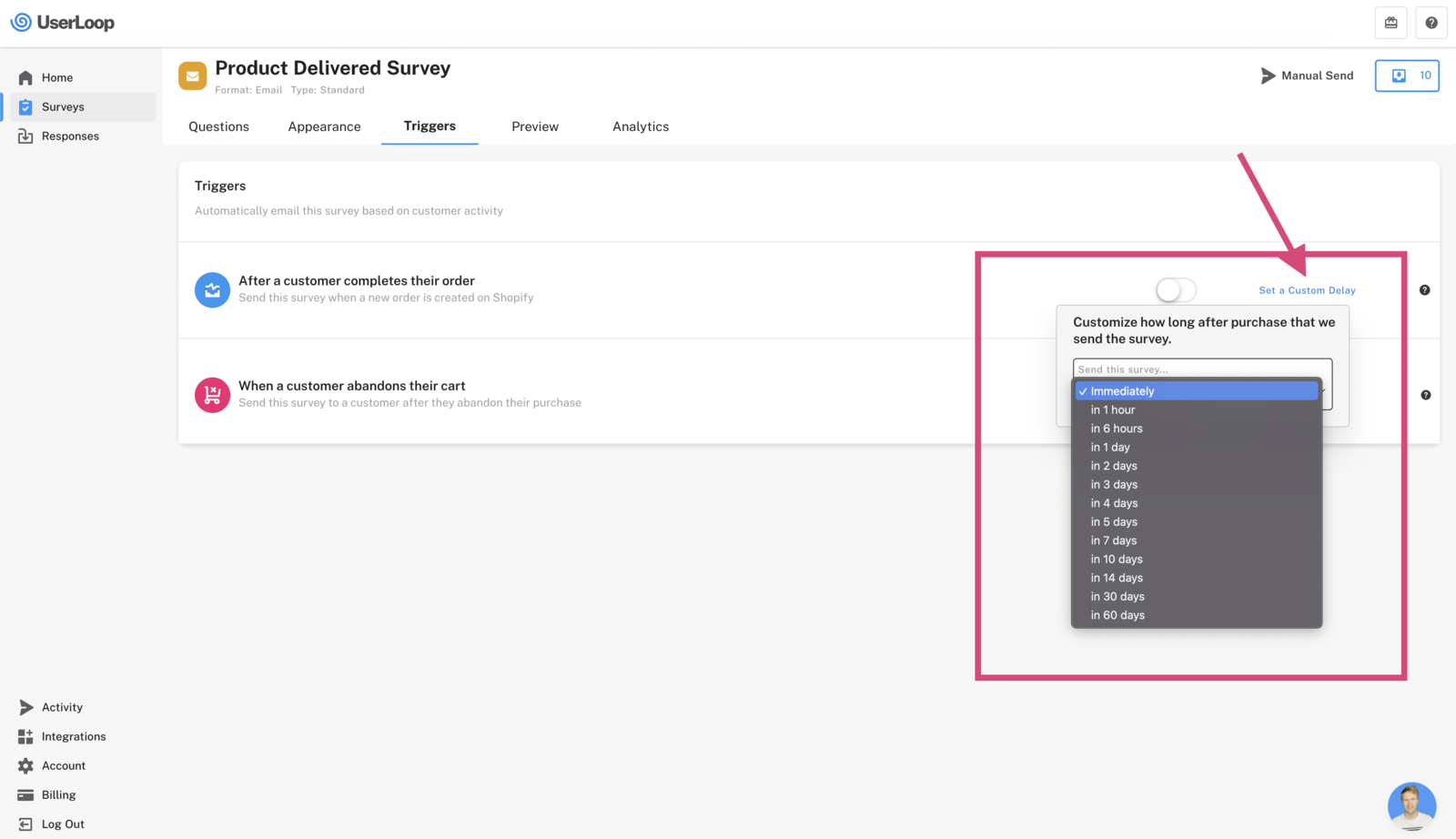
UserLoop makes this easy by allowing you to schedule your post-purchase surveys based on custom triggers.
For example, if you know the average order takes 3 days to deliver, you could delay the email survey to go out 7 days after the order is completed in Shopify.
See for yourself how easy UserLoop makes it to gather new product survey feedback. Sign up for your free trial today.


The agentic growth toolkit for Shopify
Ask your customers anything
UserLoop talks to your customers at scale with surveys and contests that feed one AI-queryable dataset. AI does the setup and the analysis.
- SurveysFind out why customers buy: checkout, email, link & QR.
- ContestsGiveaways that grow your list and social following.
Free plans on both apps · live in minutes