How to run eCommerce Surveys in 2024
Are you looking to gain valuable insights into your customers' shopping experience and boost your e-commerce business in 2024? Conducting ecommerce surveys is a powerful way to gather customer feedback, identify areas for improvement, and make data-driven decisions to enhance user experience and satisfaction.
By asking the right questions and leveraging best practices, you can unlock a wealth of information that will help you stay ahead of the competition and drive growth.
In this article, we'll dive into the world of ecommerce surveys, exploring what they are and the benefits they offer. You'll learn about the best practices for creating and distributing surveys, the types of questions to ask, and how to analyze and implement the feedback you receive.
Whether you're a seasoned e-commerce professional or just starting, this guide will provide you with the knowledge and tools you need to run effective surveys and take your online store to the next level.
What Are eCommerce Surveys?
eCommerce surveys are systematic data collection forms used in online retail to gather feedback, opinions, and insights from customers regarding their shopping experiences, preferences, and satisfaction to refine their services. The eCommerce survey questions serve various purposes, such as
- enhancing the customer experience on the website
- uncovering new product ideas
- gaining insights into customer desires and concerns
- and identifying opportunities for improving existing products.
Benefits of Conducting eCommerce Surveys
Conducting ecommerce surveys offers a wealth of benefits for online businesses looking to enhance their customer experience and drive growth.
By gathering valuable insights directly from your target audience, you can make informed decisions that lead to
increased customer satisfaction, loyalty, and ultimately, higher conversion rates.
One of the primary advantages of ecommerce surveys is the ability to identify customer pain points and areas for improvement.
By actively listening to your customers through surveys, you can uncover specific issues they face while interacting with your website or purchasing process. This valuable feedback allows you to address these pain points head-on, streamlining the user experience and removing barriers to purchase.
Improving Customer Satisfaction
Ecommerce surveys play a crucial role in improving customer satisfaction. By seeking feedback from your customers, you demonstrate that their opinions matter and that you are committed to providing them with the best possible experience. Surveys allow you to gauge satisfaction levels at various touchpoints, such as product quality, website navigation, checkout process, and customer support.

Armed with this information, you can make targeted improvements that directly address customer needs and expectations, leading to higher satisfaction rates and increased loyalty.
Identifying Pain Points
Identifying customer pain points is another key benefit of conducting ecommerce surveys. Surveys provide a platform for customers to voice their concerns, frustrations, and challenges they encounter while interacting with your online store.
By asking targeted questions, you can pinpoint specific areas that need attention, such as website usability, product information, shipping options, or payment processes.
Once you have identified these pain points, you can prioritize improvements and allocate resources effectively to resolve them, creating a smoother and more enjoyable shopping experience for your customers.
Enhancing User Experience
Ecommerce surveys are a powerful tool for enhancing the overall user experience. By gathering insights into how customers navigate your website, interact with product pages, and complete transactions, you can identify opportunities for optimization. Surveys can help you understand user preferences, such as preferred payment methods, shipping options, and communication channels.
This information allows you to tailor your website and offerings to meet customer expectations, creating a more personalized and user-friendly experience.
By continuously seeking feedback and making data-driven improvements, you can stay ahead of the curve and provide an exceptional user experience that sets you apart from competitors.
In addition to these benefits, ecommerce surveys can also help you identify new product opportunities, understand customer demographics and preferences, and measure the effectiveness of marketing campaigns.
By leveraging the power of surveys, you can gain a comprehensive understanding of your customers and make strategic decisions that drive growth and success in the competitive world of ecommerce.
Best Practices for eCommerce Surveys
To conduct effective eCommerce surveys that yield valuable insights, it's crucial to follow best practices.
Here's some of the main things to keep in mind when surveying your customers:
Ask Simple & Non-Intrusive Questions
When designing your survey, ask simple and non-intrusive questions so that your customers or respondents can freely share their reviews and opinions of your brand or business.
Keep the language of your question simple and understandable. Avoid asking leading questions that reflect your own opinions and preferences.
Use a Mix of Closed & Open-Ended Questions
Utilize a diverse range of question types, including closed formats like yes-no surveys, 1 to 5 rating scale, smiley face CSAT surveys or thumbs up down surveys, alongside open-ended questions.
This allows you to capture quantitative survey data and nuanced qualitative insights for a well-rounded understanding of shopper experiences.
Segment Your Audience
Perform user segmentation to tailor surveys to specific customer segments based on demographics, purchase history, or behavior. This ensures relevance and allows for more targeted insights.
Other best practices include:
- Multiple Survey Channels: Reach a diverse audience by deploying e-commerce questionnaires through various channels like email, website, SMS, social media or in-app notifications. This broadens your reach and captures insights from different customer touchpoints.
- Timely Surveys: Send surveys at strategic touchpoints in the user journey, such as after a purchase, post-delivery, or after customer support interactions as they capture fresh experiences and feedback.
While conducting e-commerce surveys is just one aspect of creating a seamless e-commerce customer experience, here are some additional ways to create an overall positive experience for your customers:
- Understand Customer Expectations: Prioritize client feedback to discern and hear the voice of customer to meet their expectations, utilizing their insights to identify areas for improvement and demonstrate a commitment to their needs.
- Personalize the Shopping Experience: Use consumer data to tailor recommendations and exclusive deals, creating a unique purchasing journey that will boost customer engagement and loyalty.
- Optimize Website User Experience (UX): Develop a user-friendly website with clear navigation and mobile optimization for a seamless experience. You can always gauge customer feedback using website usability survey questions to analyze areas that can be improved to offer a better visitor experience.
- Streamline the Checkout Process: Ensure a smooth checkout page with secure options and flexible payments like recurring payments and facilitating one-off purchases. Address cart abandonment by asking exit-intent survey questions in the form of popup surveys for a smooth end-to-end experience.
- Post-purchase Engagement and Feedback: Build customer loyalty by expressing gratitude through customized thank-you notes and order updates. Gather insights with post-purchase survey questions, shaping ongoing improvements and refining future performances.
Types of eCommerce Survey Questions to Ask
It's crucial to ask the right questions to gather valuable insights from your customers.
Here are some key types of eCommerce survey questions to consider:
General eCommerce Survey Questions
Start with general questions to gauge your visitors' overall experience with your website. These can include customer satisfaction survey questions, NPS survey questions, shopper experience questions, and other general questions about their perception of your brand.
Some effective general eCommerce survey questions are:
- Were you satisfied with the overall experience?
- How well does our ecommerce business meet your needs?
- How can we improve your experience?
- Do you have anything else to add?
- On a scale of 0-10, how likely would you recommend us to a friend or colleague?
Product Survey Questions
Product quality is a key factor in your buyers' purchase decisions. Regularly asking product survey questions helps you understand your products' strengths and weaknesses, enabling you to make customer-centric improvements.
Consider including these product survey questions:
- Have you ordered [PRODUCT] from us before?
- Did you find enough range of products?
- Which other options did you consider before choosing our product?
- How well does our product meet your needs?
- How satisfied are you with the quality of products?
- What do you like most/least about our product?
- Which features are the most valuable to you?
- How easy is our product to use?
- What problem would you like to solve with our product?
- How responsive have we been to your questions or concerns about our products?
- What do you think about the pricing of our products?
- How does our product differ from competitors?
- If you could change one thing about our product, what would it be and why?
- On a scale of 0-10, how likely is it that you could recommend our product to a friend or colleague?
Online Shopping Experience Questions
Providing a stellar online shopping experience is vital for customer satisfaction and loyalty. Use these questions to measure your customers' purchase experience:
- How often do you shop on this site?
- What issues do you face with shopping online?
- How was your checkout experience at our store?
- How was your payment experience at our store?
- Would you like to share your contact details?
- Do you feel safe while sharing your card details?
- On a scale of 0-10, how likely are you to buy from our store again?
Post-Purchase Questions
Post-purchase surveys, triggered right after a purchase, offer a non-intrusive way to uncover positives and negatives of doing business with you. The data gathered can be used to improve your customers' buying experience.
Ask these post-purchase survey questions:
- Are you satisfied with the products in your order?
- Did our product meet your expectations?
- What did you love most about the experience?
- What other items do you want to purchase from our store?
- What convinced you to buy from us?
- How easy was it to finalize the purchase?
- Will you purchase from us again in the future?
- How would you rate your overall experience?
- What can we do to improve your purchase experience?
- What stopped you from completing your purchase?
- On a scale of 0-10, how likely are you to recommend us to family and friends?
Customer Support and Delivery Questions
Poor customer service can cost your business dearly. Use these questions to gauge feedback about your support team and delivery services:
- To what extent do you agree with the following statement: The company made it easy to handle my issue.
- How valuable are the customer support sources we provide?
- How responsive was our customer support team?
- How helpful was our customer support team?
- Did our customer support staff solve your query?
- On a scale of 1-10, how likely will you recommend our customer support staff to a friend or colleague?
- Did you receive your order within the expected timeline?
- Did you receive your order at the shipping address?
- How was our delivery agent?
- Did our delivery agent behave professionally?
- Please rate your experience with the delivery personnel.
- How satisfied are you with the quality of our delivery services?
- How can we improve our delivery services?
By strategically incorporating these different types of eCommerce survey questions, you can gain a comprehensive understanding of your customers' experiences and preferences, enabling you to make data-driven improvements to your online store.
Optimal Channels for Distributing eCommerce Surveys
eCommerce survey questions play a crucial role in understanding customer experiences, not only after transactions but also before. By utilizing various channels, you can effectively gather valuable feedback from your customers. Let's explore the main channels through which you can distribute ecommerce survey questions and gather responses.
1. Website or In-Product Surveys for In-Moment Feedback
Your e-commerce website or your eCommerce app/product is the most ideal platform to collect eCommerce platform feedback since it allows you to measure feedback both before and after the purchase. Based on the kind of website feedback widget you wish to use and the outcome expected, you can modify the survey questions by incorporating the capabilities of generative AI.
Here's a brief explanation of the feedback widgets you can use on a website:
Feedback Button: A feedback button is a simple button that you can place anywhere on your website or product. When clicked, a website feedback button opens a survey inside a pop-up window.
Popup Survey: A website popup survey is also called an intercept survey which pops up at the predefined triggers to collect relevant feedback. For example, a popup survey can be triggered right after a transaction to collect feedback on the purchase.
Side Tab or Slide-up Survey: A side tab or slide-up survey slides out from the side or up from the bottom taking up minimal screen space. It appears when you click on the feedback button sitting on the side tab or at the bottom.
Embedded Survey: An embedded survey, unlike a feedback widget, is inserted directly into the website page. The embedded survey question is usually page-specific and the eCommerce survey question appears directly as a part of the web page. A feedback poll on a blog is a good example.
2. Email Surveys for eCommerce Feedback
Email surveys, when looking to capture eCommerce feedback, are sent after the transactions. Though you can also use email surveys to capture generic or page-specific website feedback, the participation rate may be low plus you may not be able to capture feedback at the right time.
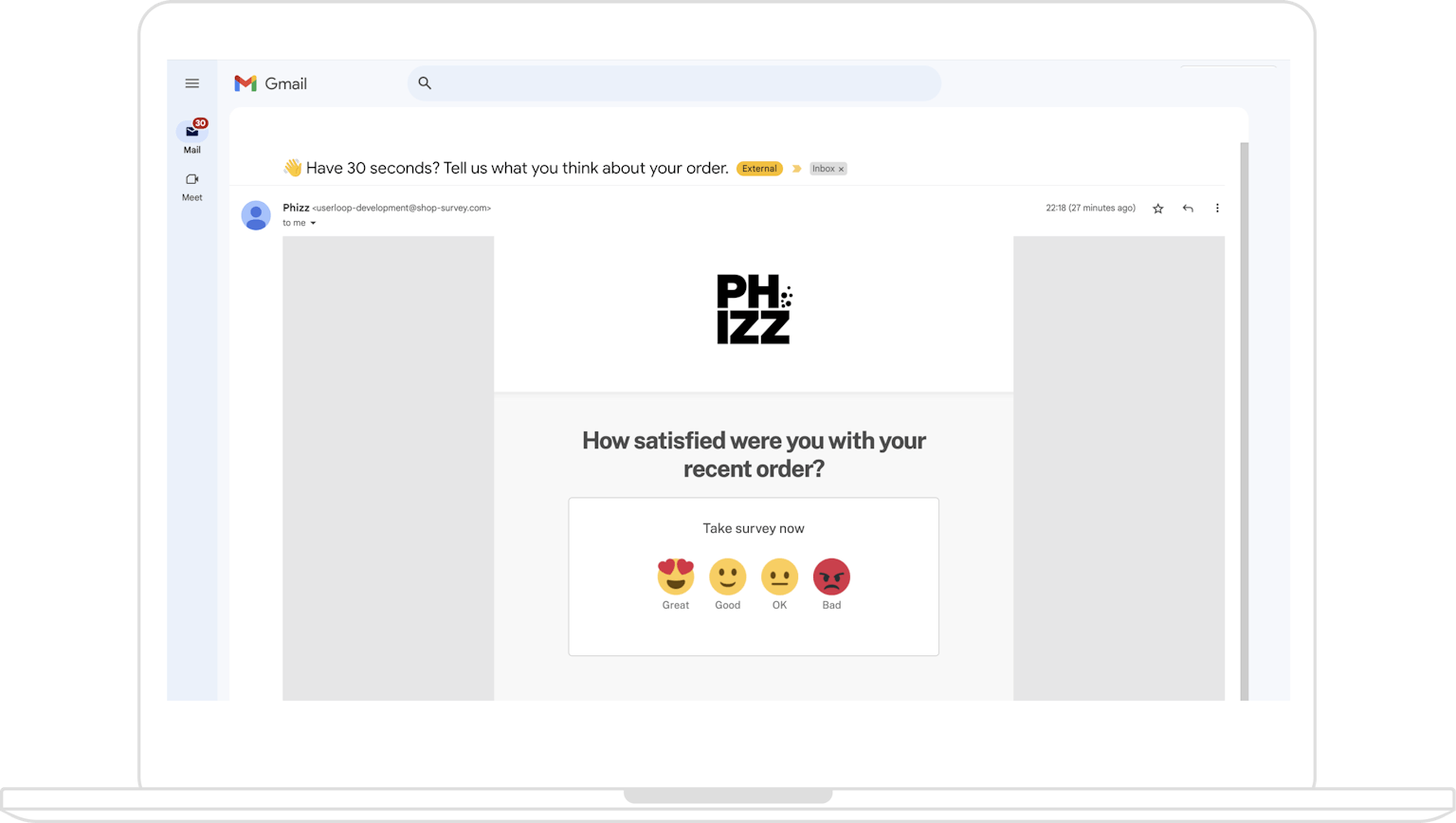
However, you can always use email surveys for post-transaction and post-delivery feedback.
You can use email survey links or buttons, email embed surveys, and an in-signature survey to gauge feedback through emails.
3. SMS Surveys for eCommerce Feedback
Most of the eCommerce survey questions to ask can also be sent via text message using SMS survey software. This enables faster and more frequent feedback collection. This is because the SMS open rate is 98%, which can improve the survey participation rate dramatically.
An eCommerce SMS survey consists of a survey link that opens in the browser to allow participants to share their responses. Moreover, with AI-based SMS survey software, you can also automate SMS surveys and send them to your customers at the right time.
For example, a post-purchase SMS survey can be triggered automatically after customers place an order to gauge their shopping experience. Similarly, post-delivery SMS surveys can be sent after the product is delivered.
By strategically incorporating these different types of eCommerce survey questions, you can gain a comprehensive understanding of your customers' experiences and preferences, enabling you to make data-driven improvements to your online store.
How to Analyze and Implement Survey Feedback
Analyzing and implementing ecommerce survey feedback is crucial for driving meaningful improvements in your online store. By leveraging survey analytics tools and integrating feedback into your business strategies, you can foster a culture of continuous improvement that enhances the customer experience and boosts your bottom line.
Using Survey Analytics Tools
Survey analytics tools play a vital role in transforming raw feedback data into actionable insights. These tools help you identify key trends, patterns, and areas for improvement by categorizing and analyzing responses efficiently. Advanced analytics tools can segment responses and perform sentiment analysis, turning raw data into actionable insights.
When selecting a survey analytics tool, consider factors such as data volume handling, advanced analytics capabilities, and integration with existing systems. Look for tools that offer customizable dashboards and drag-and-drop reporting to empower your team to explore data dynamically.
Integrating Feedback into Business Strategies
To maximize the impact of customer feedback, it's essential to integrate insights into your overall business strategies. This involves prioritizing improvement areas based on their potential to drive positive outcomes and aligning them with your strategic goals.
Continuous Improvement based on Feedback
Establishing a culture of continuous improvement based on customer feedback is key to long-term success. Regularly review and update your feedback processes to align with changing business objectives, customer expectations, and industry trends.
By leveraging survey analytics tools, integrating feedback into business strategies, and embracing a culture of continuous improvement, you can harness the power of customer feedback to drive meaningful change in your ecommerce store. Remember, the key to success lies in listening to your customers and proactively addressing their needs and concerns.
Conclusion
Conducting ecommerce surveys is a powerful strategy for gaining valuable insights into your customers' experiences and preferences. By following best practices, asking the right questions, and leveraging various distribution channels, you can gather actionable feedback that drives meaningful improvements in your online store. Analyzing and implementing survey feedback is crucial for fostering a culture of continuous improvement that enhances customer satisfaction, loyalty, and ultimately, your bottom line.
Embracing the power of ecommerce surveys is essential for staying ahead in the competitive digital landscape. By listening to your customers and proactively addressing their needs, you can create a customer-centric online store that stands out from the rest. Start surveying customers for free with UserLoop and unlock the insights you need to take your ecommerce business to new heights in 2024 and beyond.
FAQs
- What is an e-commerce survey?
An e-commerce survey is a tool used by online retailers to collect feedback from customers about their shopping experiences. These surveys help businesses understand customer preferences, satisfaction levels, and areas for improvement, allowing them to enhance products and services to better meet customer needs. They're one of the most important tools for any retailer to understand customers better. - What are the best e-commerce survey questions?
The best e-commerce survey questions include: "Were you satisfied with the overall experience?", "How well does our e-commerce store meet your needs?", "On a scale of 0-10, how likely are you to recommend us to a friend or colleague?", "How satisfied are you with the quality of our products?", "What do you like most/least about our product?", and "How was your checkout experience?" You can generate your own questions for free using our AI survey generator. - What are the predictions for e-commerce growth by 2024?
In 2024, a significant portion of e-commerce sales, specifically 40.4%, is expected to come from mobile commerce. By the following year, mobile commerce is projected to generate $710 billion, representing 10.4% of all retail transactions. This growth underscores a continuing trend where consumers increasingly prefer to shop using their mobile devices. - How is e-commerce expected to evolve by 2025?
By 2025, e-commerce is anticipated to undergo substantial changes, with a focus on innovation, convenience, sustainability, and ethical practices. The sector will likely see increased use of emerging technologies to enhance the online shopping experience. - What are the emerging trends in e-commerce?
One of the prominent future trends in e-commerce is the emphasis on sustainability. The industry is moving towards more eco-friendly practices, which include offering sustainable product options, reducing packaging waste, and overall embracing greener practices. This trend is expected to strengthen in 2024 as consumer demand for environmentally responsible options grows. - What is the expected share of online retail sales in 2024?
Online transactions are forecasted to account for 20.1% of all retail sales in 2024. This indicates a continuing decline in the number of people shopping in physical stores, as more consumers turn to online platforms for their purchasing needs.


The agentic growth toolkit for Shopify
Ask your customers anything
UserLoop talks to your customers at scale with surveys and contests that feed one AI-queryable dataset. AI does the setup and the analysis.
- SurveysFind out why customers buy: checkout, email, link & QR.
- ContestsGiveaways that grow your list and social following.
Free plans on both apps · live in minutes