NPS Survey Best Practices: How to Maximize Customer Insights
Retailers have been using the Net Promoter Score (NPS) since Fred Reichheld, a partner at Bain & Company, introduced it in 2003. Since then, best practice has evolved and its gained recognition as a quick and effective way to measure customer loyalty. Quick, as with just a single key question - "How likely are you to recommend our product to a friend or colleague? you gain a valuable benchmark of customer satisfaction.
The use of NPS surveys provides actionable insights that can improve customer retention, increase referral rates, and drive revenue. Retailers that strategically use NPS surveys, after purchases or customer support interactions, can capture a clearer picture of customer satisfaction and use that data to enhance the customer experience.
Perhaps the wisest best practice advice comes from the creator of NPS, Fred Reichheild, who points out its not the score but how you act on the score that matters.
"The goal of the Net Promoter System is not to increase your Net Promoter Score. The goal is to increase the number of customer lives you enrich on a sustainable basis. After all, the ultimate objective, the purpose of any great organization, is to improve people’s lives."
Fred Reichheild, Linkedin Article, NPS: It’s Not about the Score
Keep reading to discover how NPS surveys can help retailers and learn from our 9 top best practice tips and client scenarios.
5 minute read
Contents
What is NPS? And Why NPS Surveys Are Important for Online Retailers
Retailer Example 1 - Addressing Negative Feedback Using NPS Data
NPS Survey Best Practice
- Keep Your NPS Survey Simple
- Avoid Survey Bias
- Time Your NPS Surveys Wisely
- Segment Your Audience for Better Insights
- Act on the Feedback
- Track NPS Over Time
- Leverage NPS Analytics
- Communicate Survey Results Internally
- Incentivize Participation
Retailer Example 2 - Track sentiment and Drive Change
Conclusion
1. What is NPS?
Net Promoter Score (NPS) is a simple but powerful tool for measuring customer loyalty. It involves asking customers how likely they are to recommend your brand, product, or service on a scale of 0 to 10. Based on their responses, customers fall into three categories:
- Promoters (9-10): Enthusiastic customers who are likely to refer others and stick with your brand.
- Passives (7-8): Satisfied but unenthusiastic customers who may switch to competitors.
- Detractors (0-6): Unhappy customers who could damage your reputation with negative word-of-mouth.
Your NPS is calculated by subtracting the percentage of Detractors from the percentage of Promoters. The higher your score, the more likely your customers are to recommend your brand.
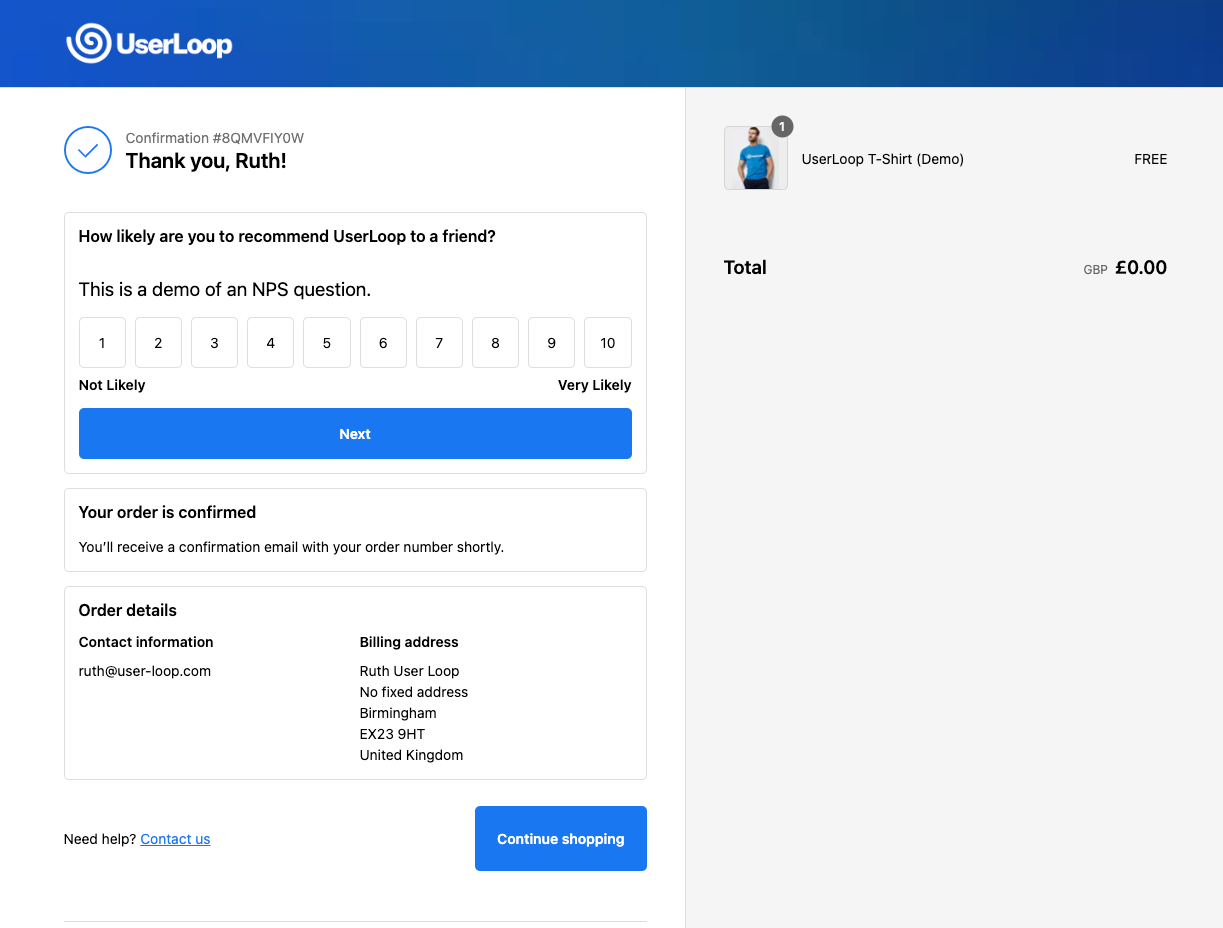 NPS Question on UserLoop Demo Store
The UserLoop easy-to-use NPS calculator makes figuring it out a breeze. Just enter the number of responses for each score below and it does all the hard work for you.
2. Why NPS Surveys Are Important for Online Retailers
For online retailers, NPS surveys provide actionable insights that go beyond traditional customer satisfaction metrics. Here's why they’re essential:
- Customer Loyalty Measurement: Retailers use NPS to gauge customer loyalty and satisfaction, providing an effective benchmark for retailers to monitor and act on.
- Increase Referrals: Loyal customers, or "promoters," are critical for driving word-of-mouth recommendations and referrals, which can boost sales without extra marketing costs.
- Actionable Feedback: NPS helps retailers identify "detractors" (unhappy customers) and take action to resolve their issues. This system enables companies to address problems quickly, reducing customer churn.
- Benchmarking: NPS is widely used across industries, making it easy for retailers to benchmark their performance against competitors. This industry-standard metric allows them to see how they compare in terms of customer satisfaction.
- Reduce Churn: By identifying Detractors early on, you can take action to resolve their issues and prevent them from leaving your brand.
- Driving Customer Experience Improvements: NPS highlights areas in the customer journey where retailers can improve, such as product quality, delivery, or customer service. Retailers can use this feedback to enhance the overall customer experience.
Retailers use Net Promoter Score (NPS) surveys as a core part of their customer feedback strategies to continuously improve the shopping experience and increase customer loyalty.
💡 See NPS survey in action - Demo Store HERE
Here are some examples of how an online retailers leverage NPS data:
Retailer Example: Addressing Negative Feedback Using NPS Data
Scenario: An online fashion retailer collects NPS feedback from customers post-purchase. After analyzing the data, they notice that their NPS has recently dropped, primarily due to negative feedback from customers who scored them 6 or below (Detractors). The primary issues identified in the open-text responses are related to product quality and shipping delays.
Actions Taken:
- Identifying Key Issues:
- The retailer segments NPS responses by different criteria (e.g., product category, geographic region) to pinpoint the areas with the most negative feedback.
- By categorizing the qualitative feedback, the retailer finds that most of the low scores relate to two main issues:
- Products not matching the description or images on the website.
- Unexpected shipping delays during peak seasons.
- Prioritizing and Implementing Solutions:
- Product Quality and Description Improvements:
- The retailer collaborates with the product team to conduct a quality check and revise product descriptions and images for the most-affected categories.
- A more robust product review process is implemented to ensure that future items are accurately represented.
- Enhancing Shipping Logistics:
- The logistics team is notified about the shipping delay issue, and steps are taken to expand partnerships with more reliable shipping carriers.
- The retailer also updates its website to set more realistic delivery timeframes during peak seasons to manage customer expectations.
- Product Quality and Description Improvements:
- Proactive Customer Outreach:
- The retailer reaches out directly to Detractors to address their concerns. They send personalized emails offering apologies, explanations for the issues, and discount codes as a goodwill gesture.
- For customers who mentioned product quality, they are offered a hassle-free return process and discounts on future purchases.
- Closing the Feedback Loop:
- To ensure continuous improvement, the retailer monitors NPS over the following months to see if these changes have a positive impact.
- They conduct follow-up surveys with previously dissatisfied customers to gauge their satisfaction after implementing the improvements.
Outcome: Within three months, the retailer sees a significant improvement in their NPS score, as product-related complaints decrease by 40% and shipping-related issues drop by 30%. Customers appreciate the proactive outreach, leading to increased loyalty and positive word-of-mouth.
Key Takeaways:
- NPS data helps identify specific pain points in the customer journey.
- Addressing negative feedback with concrete actions and proactive communication can turn unhappy customers into loyal advocates.
- Closing the feedback loop and tracking changes over time is crucial to ensure that initiatives are effectively improving customer satisfaction.
This approach demonstrates how NPS data can be leveraged to make targeted improvements and build stronger relationships with customers.
By consistently tracking NPS, online retailers can make data-driven decisions that improve customer satisfaction, boost retention, and drive sales.
NPS Best Practice
To get the most out of your NPS surveys, it’s important to follow some best practices. Let’s explore the key steps to creating effective NPS surveys.
1.Keep Your NPS Survey Simple
The beauty of NPS surveys lies in their simplicity. They consist of one primary question: "How likely are you to recommend us?" But you can add a follow-up question to dig deeper. For example, ask, "What’s the main reason for your score?" This open-ended question gives customers a chance to explain their rating in their own words, offering richer insights.
Tip: Limit additional questions to avoid survey fatigue. Keep the focus on the NPS question and a single follow-up for more clarity.
2.Avoid Biasing the Survey Design
Ensure the survey doesn’t push customers toward a certain answer. This means avoiding leading questions or framing language that could influence the response. For instance, don’t ask, “Would you recommend us, given our amazing new product?” Keep the question neutral to collect genuine responses
3.Time Your NPS Surveys Wisely
Timing is crucial to collecting accurate feedback. The best time to send an NPS survey depends on your customer’s journey with your brand:
- Post-purchase: Right after a purchase or delivery is a great time to gauge satisfaction.
- After customer support: Survey customers after they’ve interacted with your support team to understand if their issue was resolved.
- At regular intervals: Send NPS surveys at key stages (e.g., after 6 months or a year of service) to measure ongoing loyalty.
Avoid Over-Surveying - Sending too many NPS surveys can irritate customers, leading to survey fatigue and lower response rates. Striking a balance between collecting enough feedback and not overwhelming customers is key. It’s usually best to send surveys periodically or after meaningful interactions(
Tip: By strategically sending NPS surveys at the right moment, you’ll capture more accurate customer sentiment.
4.Segment Your Audience for Better Insights
Not all customers have the same experience with your brand, which is why segmentation is key. Group your survey respondents based on relevant factors, such as:
- Purchase frequency
- Demographics (age, location, etc.)
- Customer lifetime value
Don't Just Survey Only Happy Customers you think had a positive experience. Include a broad range of customers to get a complete picture of overall satisfaction.
Tip: By analyzing NPS results by segment, you can uncover trends and understand how different customer groups feel about your product. For instance, loyal customers may give higher scores, while new users might offer suggestions for improvement.
5.Act on the Feedback
One of the biggest mistakes companies make is failing to act on NPS feedback. Once you've collected responses, it's important to close the loop with your customers. Here's how:
- Follow up with detractors (those who rate you 0-6) to understand their pain points and offer solutions.
- Thank your promoters (those who rate you 9-10) and encourage them to leave a review or share their positive experiences.
- Engage with passives (those who rate you 7-8) to find out what would make their experience even better.
Tip: Taking immediate action not only improves your NPS score over time but also shows customers that their opinions matter.
6.Track NPS Over Time
NPS is not a one-time survey. It’s important to track your score regularly and monitor trends over time. Set up a schedule to conduct your NPS survey at consistent intervals, such as quarterly or annually, so you can spot patterns and act on any recurring issues.
Tip: You should also compare your NPS with industry benchmarks to see how your company stacks up against competitors.
7.Leverage NPS Analytics
To get the most out of your NPS survey, make use of analytics tools that can help you dive deeper into the data.
AI-powered survey tools like UserLoop analyze open-ended responses to highlight common themes and pain points. You can segment the data by customer spend, AOV, or behavior, helping you identify high-value customers and tailor your marketing efforts accordingly.
8.Communicate Survey Results Internally
NPS feedback is a goldmine of information that should be shared across departments. Here’s how different teams can benefit:
- Product teams: Understand which features customers love or what improvements are needed.
- Customer support: Learn how to resolve common pain points.
- Marketing: Use positive feedback to create case studies or testimonials.
Tip: By aligning all teams with NPS insights, you can create a more customer-centric culture.
9.Incentivize Participation
To maximize response rates, consider offering incentives such as discount codes, gift cards, or other rewards for completing your survey. This approach can encourage more customers to share their feedback, giving you a larger pool of data to work with.
However, be careful not to offer rewards in a way that influences their honesty. The goal is to get genuine feedback, not just higher scores.
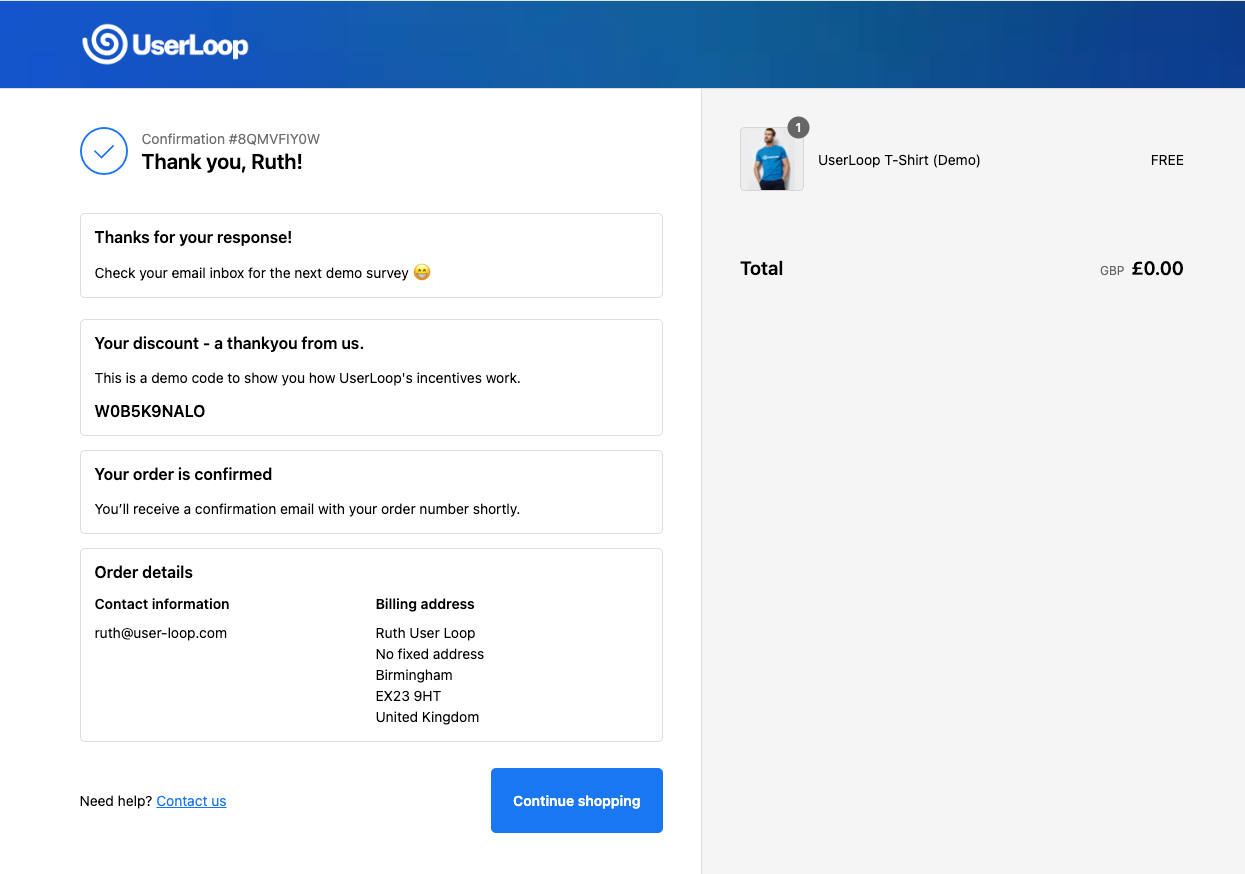 Discount Code Incentive
Tip: When running an NPS survey, retailers should be mindful of several common mistakes that can reduce the effectiveness of their feedback and mislead results.
💡 Test out a NPS survey on our Demo Store
Retailer Example - Global US retail giant & sports equipment
The retailer conducted NPS and customer satisfaction surveys focusing on key areas like communication, pricing, and the portal experience. By doing so, they were able to pinpoint the exact elements that impacted merchant satisfaction or dissatisfaction. This enabled the retailer to implement targeted improvements, leading to a better marketplace experience and ultimately boosting their NPS by 16 points.
Another example is company selling premium acupressure mats online, that uses NPS feedback to identify brand advocates and incorporate their input into marketing strategies. By embedding NPS questions into emails and automating the process, the company improved its survey response rate and leveraged the data to increase brand advocacy, which in turn led to more positive reviews and higher customer satisfaction.
These examples illustrate how online retailers can harness NPS data not only to track customer sentiment but also to drive meaningful changes that enhance customer experiences and resolve pain points effectively.
Conclusion
An effective NPS survey goes beyond collecting a score; it helps you understand your customers on a deeper level and improve customers lives. By following these NPS survey best practices, you can increase customer loyalty, identify areas for growth, and improve outcomes for customers and businesses. Remember to keep surveys simple, segment your audience, act on feedback, and track NPS over time to see the biggest impact.
Looking for an easy way to implement these best practices? UserLoop can help you create, distribute, and analyze NPS surveys effortlessly, providing you with the insights you need to grow your business. Head over to the Shopify App store to download your free trial.


The agentic growth toolkit for Shopify
Ask your customers anything
UserLoop talks to your customers at scale with surveys and contests that feed one AI-queryable dataset. AI does the setup and the analysis.
- SurveysFind out why customers buy: checkout, email, link & QR.
- ContestsGiveaways that grow your list and social following.
Free plans on both apps · live in minutes