How Do You Analyze Survey Data: What to Look For and What to Avoid
Retailers collect vast amounts of customer data to understand purchasing behaviors and enhance the shopping experience. However, collecting customer feedback is just the first step— how do you analyze survey data efficiently and at scale, so teams can deliver actionable insights and sales growth.
It is tempting for brands to funnel resources into methods that boost engagement, but if brands are not actively analyzing survey results they are likely to waste resources by focusing on things that aren’t important to customers.
In this article we examine key benefits to gathering insights at scale, how to analyze survey data, key metrics to track during survey analysis, as well as what good results look like and what to avoid doing.
Why should E-Commerce Brands Analyze Customer Survey Data
For e-commerce businesses, customer survey analysis is a goldmine of insights that can drive growth.
1. Improve the Online Shopping Experience
- Why it matters: E-commerce relies heavily on a seamless digital experience. Surveys can reveal pain points such as website navigation, checkout issues, or product search challenges.
- Example: Discovering that customers struggle with mobile checkout and optimizing the process for better conversions.
💡 The State Of Commerce Experience, a commissioned report conducted by Forrester Consulting on behalf of Bloomreach, found that nearly half of buyers (40% of consumers and 56% of B2B customers) would pay more for a better experience, and would not buy from the same business again if the experience had been poor
2. Increase Customer Retention and Loyalty
- Why it matters: Loyal e-commerce customers drive repeat sales and are more cost-effective than acquiring new ones. Although benchmarks do vary , most ecommerce retailers have 25-30% percent returning customers. This is backed up by Alex Schultz, VP of Growth at Facebook who says, “If you can get 20-30% of customers coming back every month and making a purchase from your store, you should do pretty well”.
- Example: Learning that customers appreciate fast delivery options and introducing same-day shipping to boost loyalty.
3. Fine-Tune Product Offerings
- Why it matters: E-commerce businesses can use survey feedback to identify which products are meeting expectations and which ones are falling short.
- Example: Using surveys to find out which product categories customers want expanded, helping guide inventory decisions.
4. Identify and Fix Fulfilment and Delivery Issues
- Why it matters: Delivery speed, cost and reliability are critical in e-commerce, for instance a recent survey by McKinsey & Company showed that ninety percent of consumers are likely to abandon shopping carts that feature high shipping costs for standard items. Surveys can reveal issues like late deliveries, attitudes to sustainable shipping or shipping costs, and if goods are received damaged, or confusion about return policies.
- Example: Customers complaining about delayed shipments might lead to partnerships with faster shipping providers.
5.Understand and Capitalize on Customer Trends
- Why it matters: E-commerce thrives on staying ahead of consumer trends, and surveys are a direct window into evolving preferences and behaviors.
- Example: Identifying a growing demand for eco-friendly packaging or sustainable products and adjusting offerings accordingly.
💡 Interest in sustainable shipping is increasing - According to research from McKinsey & Company, more than one-third of consumers are willing to pay an additional one or two dollars for more sustainable shipping.
All of these insights are hidden in your data and by integrating AI-powered tools for survey analysis, e-commerce businesses can efficiently uncover actionable insights, optimize operations, and strengthen customer relationships, giving them a competitive edge in the online marketplace.
When to gather feedback in the e-commerce customer journey
Gathering feedback at key touchpoints in the e-commerce customer journey helps retailers optimize the experience, improve conversions, and build customer loyalty. Here are the most effective points for collecting online feedback:
1. Browsing Stage (Pre-Purchase)
- Exit-Intent Surveys: Capture feedback from visitors who are about to leave without purchasing to understand why they didn’t convert.
- On-Site Chat/AI Prompts: Ask about product preferences or if they found what they were looking for.
2. Checkout Process
- Abandoned Cart Surveys: If a shopper leaves their cart, a quick survey via email or pop-up can reveal barriers (e.g., high shipping costs, unclear return policies).
- Checkout Experience Feedback: Ask if the process was smooth or if they encountered issues.
3. Post-Purchase (Immediately After Checkout)
- Post-Purchase Surveys: Gather insights on purchase motivations, product expectations, and overall experience while it's fresh in the customer’s mind.
4. Order Fulfilment & Delivery
- Order Confirmation Email Surveys: Understand if customers had issues with payment, checkout, or choosing a product.
- Delivery Experience Feedback: After the order arrives, ask about shipping speed, packaging, and condition of the item.
5. Post-Usage (After Product Experience)
- Product Reviews & Ratings: Encourage customers to share their thoughts on the product itself, influencing future buyers.
- Customer Satisfaction (CSAT) or Net Promoter Score (NPS): Ask if they would recommend the product or brand.
6. Customer Support Interactions
- Post-Support Feedback: If they contacted customer service, ask about the resolution quality and response time.
7. Retention & Loyalty Checkpoints
- Repeat Customer Feedback: Gather insights on why they returned or what could enhance their experience.
- Subscription or Loyalty Program Feedback: For subscribers or loyalty program members, ask about the value of the program.
By collecting feedback across these touchpoints, e-commerce businesses can continuously refine their customer journey, improve retention, and boost sales.
Key Metrics to Track - Post Purchase
As well as the question - "how do you analyze survey data?" you need to ask "what survey's should we undertake?. At UserLoop we see the highest value from post-purchase surveys. Why? because the post-purchase moment is a highly effective time to collect data because customers have just completed their transaction, making their experience, motivations, and potential friction points fresh in their minds. We find, at this stage, they are more likely to provide honest and detailed feedback, giving retailers valuable insights to refine their marketing, optimize the buying journey, and enhance customer satisfaction.
Post-Purchase: Excellent key metrics to track for survey analysis. They provide critical insights into customer satisfaction, purchase experience, and overall impressions of your product or service.
Consider these statistics in your post purchase survey analysis:
- Customer Satisfaction (CSAT): This is usually measured on a scale (e.g., 1-5 or 1-10). A CSAT score of 80% or higher is a strong indicator that customers are satisfied with their experience.
- Net Promoter Score (NPS): This measures how likely a customer is to recommend your store. A good NPS is typically above 50, with 70+ being exceptional.
- Recurring Themes: Look for trends in open-ended responses, such as recurring praise (e.g., “fast shipping”) or complaints (e.g., “hard to navigate checkout”).
- Response Rate: A higher response rate (above 10-15%) indicates that your customers are engaged and willing to share feedback.
What Good Results Look Like
Good results will vary by industry, but here’s what e-commerce retailers should aim for:
- High Ratings on Core Questions: For example, a majority of customers rating their experience as “very satisfied” or “excellent.”
- Actionable Insights: Specific feedback that identifies clear areas for improvement, like faster shipping times or a better product description.
- Positive Open-Ended Feedback: Comments that highlight what you’re doing well, such as outstanding customer service or product quality.
Identifying Actionable Insights
Within your search to understand "how do you analyze survey data" you will hear the term actionable insights but just what does actionable insights mean?
Actionable insights from survey data are findings that are specific, relevant, and directly influence decision-making. They go beyond just identifying trends—they provide a clear direction for improving customer experience, optimizing marketing strategies, or refining product offerings.
A great way to define this is:
💡 Data becomes an actionable insight when it not only explains what happened but also provides a clear path on what to do next.
To determine if a survey result is actionable, ask:
- Is it specific? Does it pinpoint a clear issue or opportunity?
- Is it relevant? Does it align with business goals or customer needs?
- Is it changeable? Can the business take direct action to improve or optimize based on the insight?
For example, if post-purchase surveys reveal that 30% of customers abandon checkout due to unexpected shipping costs, an actionable insight would be:
"Reducing or clearly displaying shipping costs earlier in the shopping journey could improve conversion rates."
By focusing on insights that lead to measurable improvements, businesses can move beyond just collecting data to making meaningful, customer-driven changes.
Use tools like UserLoop to segment and analyze responses to help add detail and make insights actionable. For example:
- Segment by Order Value: Are high-spending customers reporting a better or worse experience than average?
- Track Changes Over Time: Compare feedback before and after implementing a new policy or feature to see if it had a positive impact.
- Analyze Negative Feedback: What’s causing dissatisfaction? Is it a one-off issue or a systemic problem?
What Retailers Should Be Aiming For
A successful post-purchase survey program should help you:
- Reduce Negative Feedback: By identifying and fixing common issues, fewer customers should report dissatisfaction over time.
- Boost Customer Loyalty: Your CSAT and NPS scores should steadily improve, reflecting happier customers who are more likely to return.
- Generate Valuable Ideas: Customer suggestions can inspire new products, services, or process improvements.
- Validate Positive Trends: If customers are repeatedly praising certain aspects of your store, lean into those strengths and amplify them in your marketing.
Use Feedback to Set Goals and Track Progress
For example, if your current NPS is 45, set a goal to reach 60 within the next quarter. Regularly measure results and adjust strategies to ensure continuous improvement.
How to Utilize AI to Save Time and Resources with your Survey Analysis
If you have read the article so far and wondered how your team will managed the additional workload, don't worry. Today AI-powered tools, such as UserLoop leverage AI and are designed to streamline survey analysis, providing actionable insights efficiently and supercharging results. By processing all survey responses, they deliver summaries for each question, highlighting key areas for improvement in an e-commerce store. This approach saves time and resources by automating the analysis process, allowing brands to focus on implementing changes based on the insights provided.
AI-powered survey analysis offers several benefits:
- Speed and Efficiency: AI can process large volumes of data quickly, providing rapid insights.
- Accuracy and Objectivity: AI algorithms offer unbiased analysis, detecting nuanced patterns and sentiments that might be missed by human analysts.
- Scalability: AI systems can handle increasing data loads as your business grows, ensuring efficient analysis of customer feedback.
By integrating AI into your survey analysis, you can gain a comprehensive understanding of customer needs and preferences, leading to informed decision-making and enhanced customer satisfaction.
Examples of AI-Powered Analysis from UserLoop
Here are just a few examples of some of the AI-powered reports that UserLoop provides to ensure you get maximum value from your customer survey data.
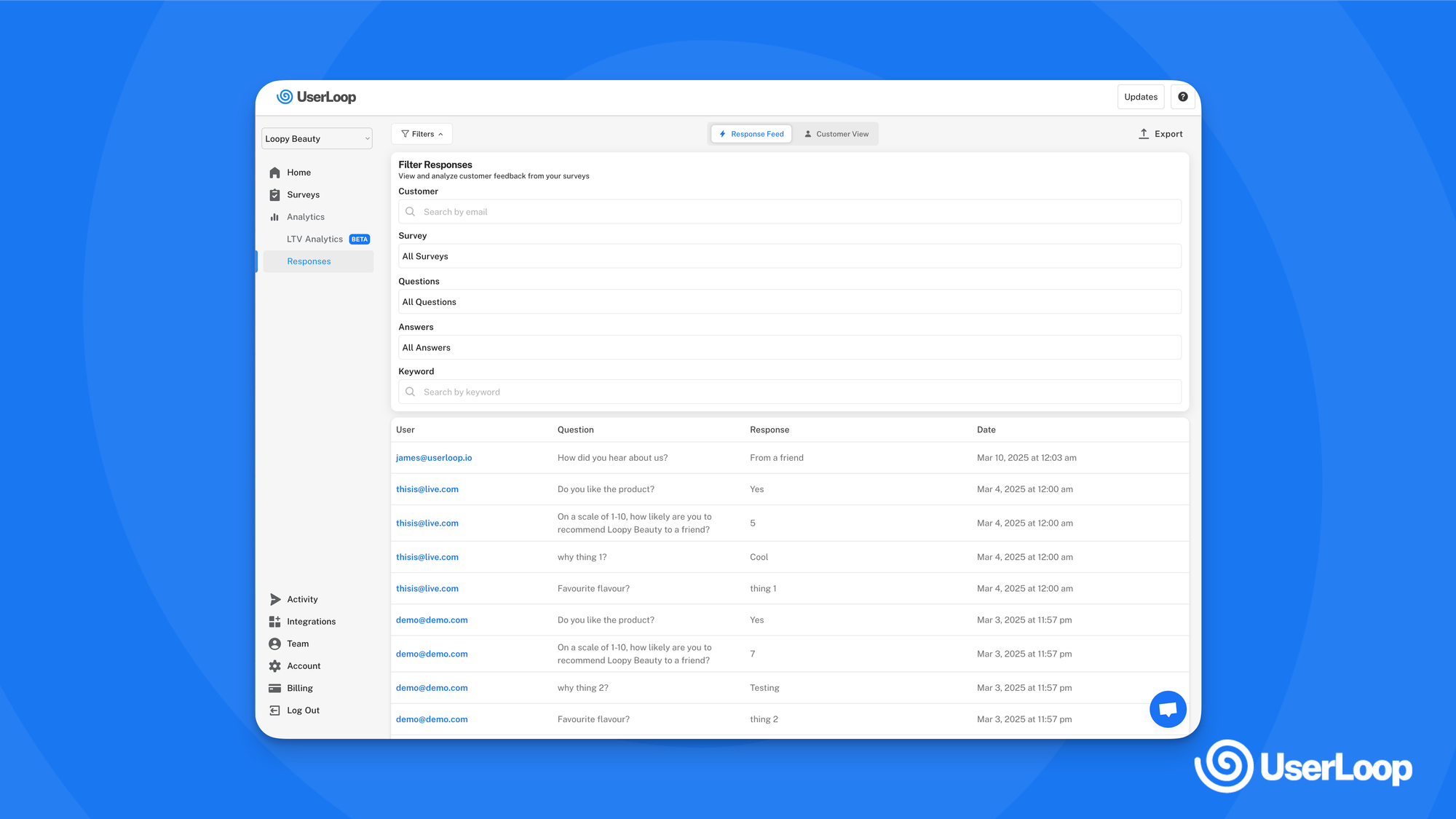 Live feed of responses and advanced filtering
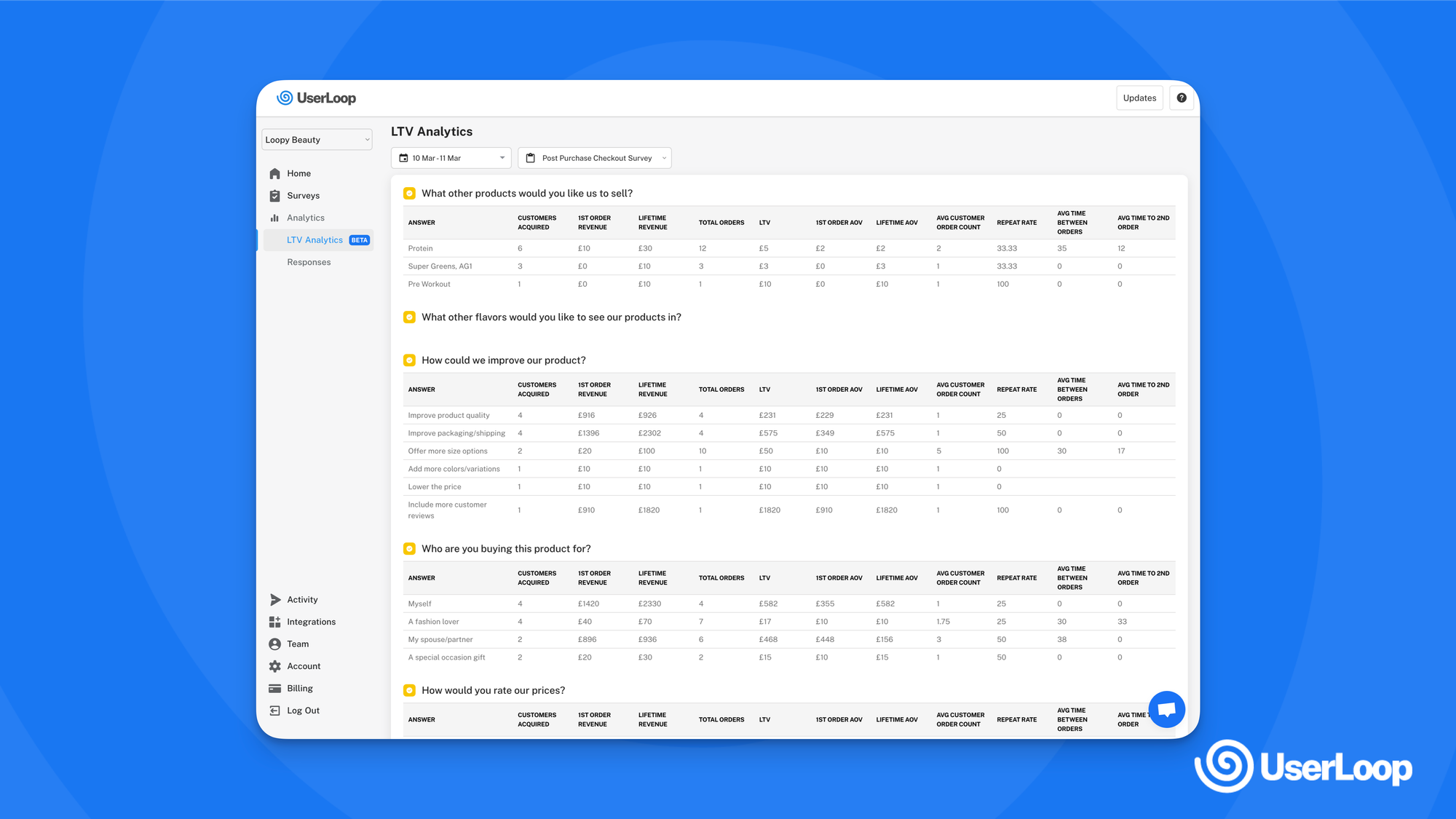 LTV Analytics, showing revenue impact for each answer over time
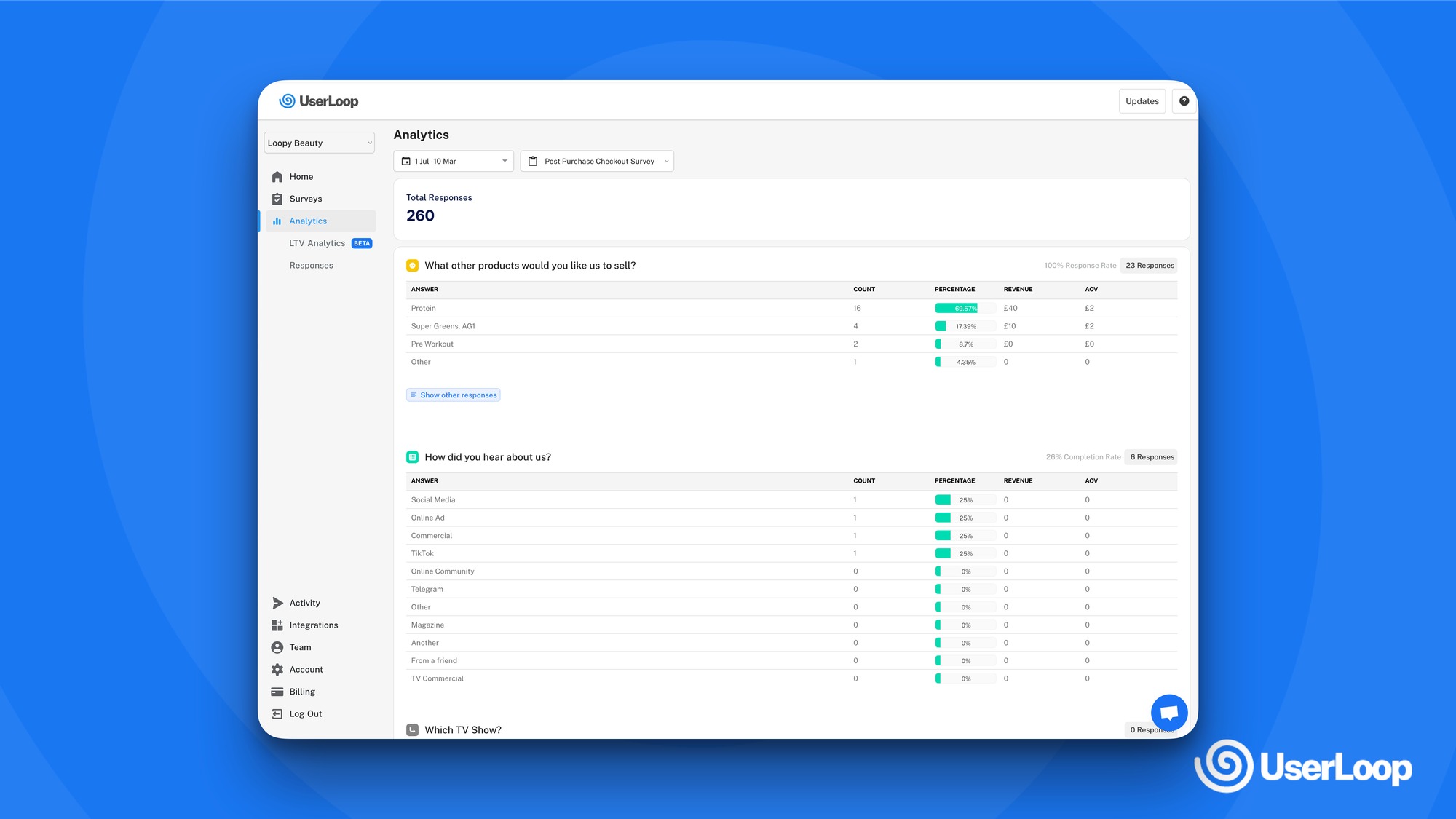 Analytics with breakdown views, percentages and revenue info
💡 Find out more in our blog - How Intelligent AI Transforms Customer Feedback into e-Commerce Growth
What to Avoid Doing
When analyzing post-purchase survey results, it’s just as important to know what not to do. Avoid these common pitfalls:
- Ignoring Negative Feedback: Don’t dismiss critical comments as outliers. Even a few negative responses can indicate a larger, underlying problem.
- Overlooking Trends: Focusing solely on individual responses without identifying recurring themes can lead to missed opportunities for meaningful improvement.
- Chasing Perfection: Striving for a 100% CSAT or NPS is unrealistic and can lead to unnecessary stress. Focus on consistent, incremental improvements instead.
- Failing to Close the Loop: If you collect feedback but don’t act on it, customers may feel unheard, reducing their likelihood of participating in future surveys.
- Overcomplicating Analysis: Using overly complex tools or metrics can make it harder to take actionable steps. Stick to a few key metrics and clear insights.
By analyzing your results thoughtfully, you’ll not only improve your e-commerce experience but also build stronger relationships with your customers. After all, listening is the first step to keeping them happy—and happy customers are the key to a thriving business.
UserLoop
UserLoop offers a powerful customer feedback platform that help store owners collect insights at every stage of the customer journey. With UserLoop, you can run a wide range of customer experience surveys at checkout, through email, or via links. These surveys gather valuable data on customer satisfaction, product preferences, and more.
The platform uses AI to help craft survey questions and analyze responses, making it easy to understand and act on customer feedback. Store owners can use the data to identify high-value customer segments, uncover issues affecting conversion, and optimize the overall shopping experience. Features like automated discount codes and integrations with Shopify make it simple to boost response rates and leverage feedback to drive growth.


The agentic growth toolkit for Shopify
Ask your customers anything
UserLoop talks to your customers at scale with surveys and contests that feed one AI-queryable dataset. AI does the setup and the analysis.
- SurveysFind out why customers buy: checkout, email, link & QR.
- ContestsGiveaways that grow your list and social following.
Free plans on both apps · live in minutes